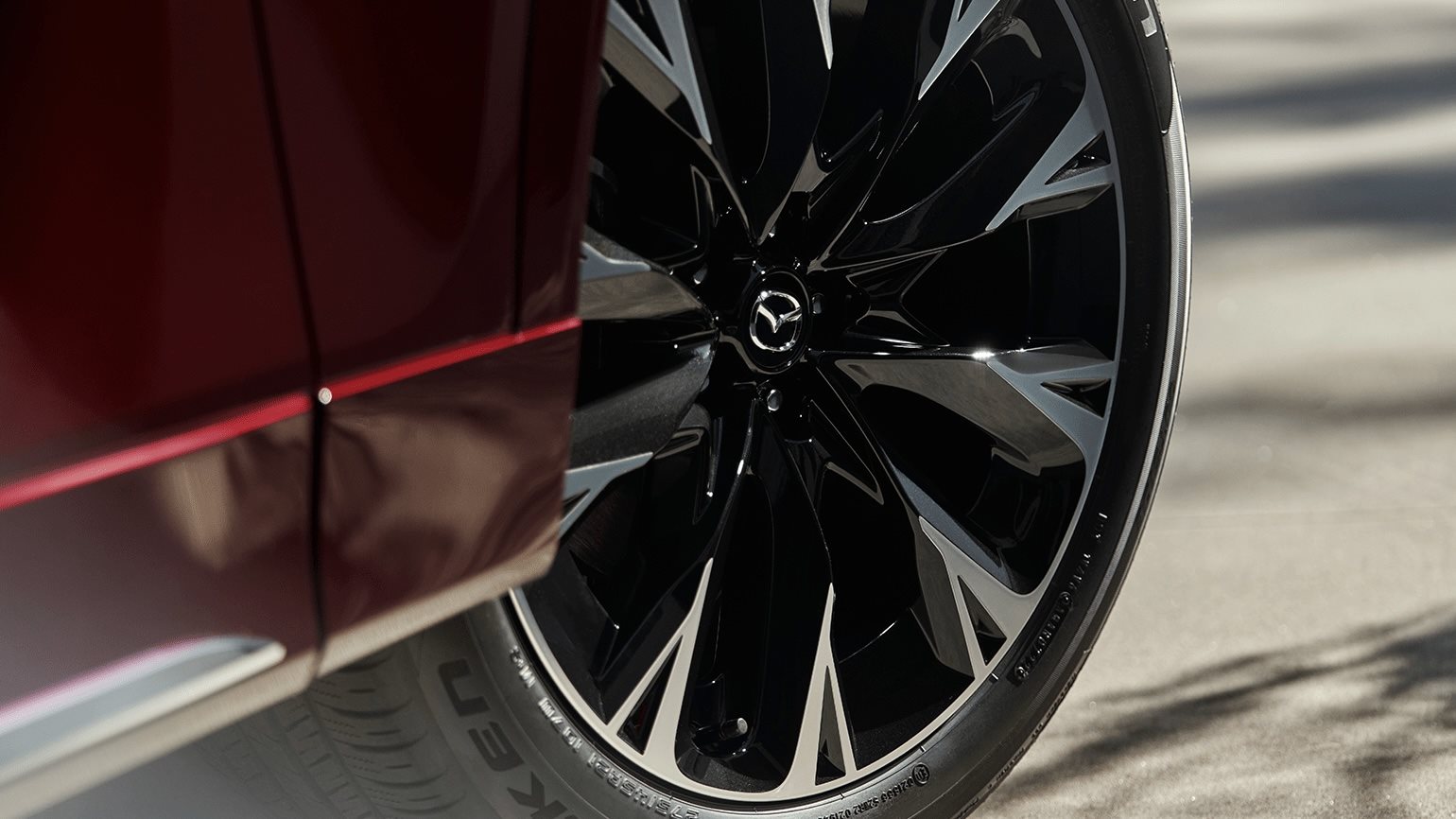
Mazda tire pressure should match the label on the driver door frame, not the number molded on the tire. Several 2025 U.S. Mazda configurations listed below specify 36 psi cold front and rear. Exceptions include the Mazda3 and CX-30 2.5 Turbo front tires, the CX-50 on 20-inch wheels, and the CX-5, which specifies 34 or 35 psi depending on tire size. Set pressure with the tires cold and check it at least monthly.
That matters in Miami. Temperature changes and heat from driving can raise or lower the reading. A warning that disappears later in the day still calls for a cold pressure check.
Brickell Mazda Service, 618 SW 8th St, Miami, FL 33130
Service: (786) 481-4541 | Mon to Fri 7:00 AM to 6:00 PM, Sat 8:00 AM to 4:00 PM, Sun closed
Covered here: cold tire pressure checks, TPMS warning diagnosis, tire rotation, tire replacement, and Mazda warning-light inspections. Schedule service online.
What should Mazda tire pressure be?
The table provides examples from the linked 2025 U.S. owner's manuals. It is not a specification for every Mazda, model year, powertrain, or replacement tire setup. Your vehicle's door label and applicable owner's manual determine the recommended pressure for its original equipment configuration. Ask a qualified tire professional about nonstandard tire or wheel fitments.
| 2025 U.S. model / configuration | Tire size | Front, cold | Rear, cold |
|---|---|---|---|
| Mazda3, non-turbo | 205/60R16 or 215/45R18 | 36 psi | 36 psi |
| Mazda3, 2.5 Turbo | 215/45R18 | 38 psi | 36 psi |
| CX-30, non-turbo | 215/65R16 or 215/55R18 | 36 psi | 36 psi |
| CX-30, 2.5 Turbo | 215/55R18 | 38 psi | 36 psi |
| CX-5, 17-inch | P225/65R17 | 34 psi | 34 psi |
| CX-5, 19-inch | P225/55R19 | 35 psi | 35 psi |
| CX-50, configurations in linked manual | 225/65R17 or 225/60R18 | 36 psi | 36 psi |
| CX-50, 20-inch | 245/45R20 | 35 psi | 35 psi |
| CX-90, configurations in linked manual | P255/60R18, 265/55R19 or 275/45R21 | 36 psi | 36 psi |
Source: Mazda North American Operations, linked 2025 owner's manual specification pages, reviewed October 9, 2026. Figures apply to the configurations shown and exclude temporary spare tires. Other model years and separately documented configurations may differ.
Do not fill to the sidewall maximum. Use the vehicle manufacturer's recommended cold pressure, as explained in NHTSA's tire safety guidance.
Why does the tire pressure light come on at dawn and go off by noon?
A tire that is already underinflated can lose additional pressure as it cools overnight. Warming and driving can raise pressure enough for the warning to disappear. That does not establish the exact pressure or prove a slow leak.
Federal safety standard FMVSS 138 requires TPMS detection within specified test conditions and timing when pressure reaches 25 percent below the manufacturer's recommended cold pressure or a tire-type minimum specified by the standard, whichever is higher. As a mathematical example, 25 percent below 36 psi is 27 psi. This is not a confirmed activation threshold for every Mazda, and it is not a safe inflation target.
Temperature changes affect pressure. Michelin describes an approximate change of 1 psi for every 10°F. Mazda's CX-5 manual also explains that pressure falls as tire temperature falls. A warm reading after driving should not be treated as a cold reading; do not bleed air from warm tires merely to match the cold specification.
Check all four tires cold against the door label. If pressure drops again after adjustment, have the tires, valves and wheels inspected for leaks. Possible explanations include temperature changes, inadequate initial inflation, or a leak; diagnosis requires measurements and inspection.
How much do Miami temperature swings change tire pressure?
A 13 to 15°F temperature change corresponds to roughly 1.3 to 1.5 psi using that approximation. NWS Miami's 1991 to 2020 daily normals for Miami International Airport show mid-January highs and lows around 76°F and 61°F, and mid-July around 91°F and 78°F. These are outdoor-air averages, not measurements of a particular tire's temperature or pressure.
Cold fronts can produce larger changes. NWS Miami's 2020 to 2021 winter summary documents lows in the upper 30s and 40s across much of South Florida during an outbreak. A 30°F temperature decrease would correspond to about 3 psi using the same approximation. Actual changes depend on the tire's starting temperature, driving, sun exposure and other conditions.
Is it a low tire or a TPMS malfunction?
After the startup lamp check, a steady tire pressure warning generally indicates low pressure. A light that flashes for about a minute and then stays on indicates a TPMS malfunction on vehicles using this combined warning pattern. FMVSS 138 specifies a 60 to 90 second flashing sequence for a combined malfunction telltale; follow your model's owner's manual and dashboard messages.
A malfunction does not necessarily mean a failed sensor. Mazda's CX-5 manual lists possible causes including exhausted sensor batteries, radio interference and wheels without compatible sensors. Check the tire pressures manually even when the system reports a fault.
After tire or wheel changes, sensor ID registration may be needed. For the 2025 Mazda3, the manual specifies waiting more than 19 minutes, then driving at 16 mph or faster for at least three minutes. This is model-specific: the CX-5 procedure differs. Do not attempt a registration drive until tire condition and pressure are safe; follow the applicable manual or have a technician complete it.
A cold pressure check, inspection for leaks and TPMS diagnosis can help distinguish low inflation from a system fault. Normal sensor operation alone does not prove a tire needs repair. Inspection determines whether pressure adjustment, tire or valve repair, sensor service, or another repair is appropriate.
How serious is a Mazda warning light?
Follow the specific warning and accompanying message rather than relying on color alone. The examples below draw on the linked 2025 CX-5 and Mazda3 manuals; equipment and instructions vary by vehicle.
| Light | What it may mean | What to do |
|---|---|---|
| Engine oil pressure (CX-5) | Oil pressure has decreased (source) | Stop safely, shut the engine off, and contact a Mazda dealer. Do not continue driving with the warning on. |
| Engine oil level, amber (CX-5, where equipped) | Oil level is near the MIN mark (source) | Park on level ground and check the dipstick following the manual. Add the specified oil if needed, without overfilling. |
| Check engine | Possible engine or emissions fault; a loose fuel cap is one listed cause (source) | Check that the fuel cap is secure where applicable. If the light remains on or flashes, avoid high speeds and contact a Mazda dealer as soon as possible. If the engine runs roughly or the vehicle loses power, stop safely and arrange assistance. |
| i-ACTIVSENSE, amber (Mazda3) | A driver assistance system may have a malfunction (source) | Read the accompanying message and follow the manual. Do not rely on the affected assistance feature; have a persistent warning inspected. |
| Tire pressure, solid after startup | One or more tires may be significantly underinflated. | Reduce speed, stop safely, and check tire condition and pressure. Inflate to the door-label specification when cold; investigate recurring pressure loss. |
| Tire pressure, flashing then solid | The TPMS may have a malfunction. | Check tire pressure manually and arrange diagnosis. The system may not reliably warn of low pressure. |
Some assistance warnings can occur when a camera's viewing area or radar sensor is obstructed. Follow the cleaning and troubleshooting instructions for your specific system; do not assume cleaning resolves a malfunction. For check engine causes, see our Mazda check engine light guide for Miami drivers.
Tire pressure checks and tire offers at Brickell Mazda
If the warning appears, check all four tires cold using a reliable gauge. If pressure remains correct and the warning clears, continue monthly checks and monitor for recurrence. If one tire repeatedly loses pressure, the warning persists after proper inflation, or the light flashes, arrange inspection.
Our Mazda tire rotation special starts at $54.95 and includes a tire pressure check, tread depth inspection and multi-point inspection.
Rotation offer terms, reviewed October 9, 2026: Price applies to standard passenger vehicles; some vehicles may require additional time or cost. Present the offer when the order is written. Cannot be combined with other offers or previous purchases. See dealer for eligible vehicles and details. Offer expires October 31, 2026.
Replacing tires? The buy three eligible tires, get 50 percent off the fourth offer applies to eligible OEM, OEA and WIN customer-pay tires from participating brands.
Tire purchase offer terms, reviewed October 9, 2026: Eligible brands include BFGoodrich, Bridgestone, Continental, Cooper, Dunlop, Falken, Firestone, General, Giti Tire, Goodyear, Hankook, Kumho, Michelin, Nexen, Nokian, Pirelli, Toyo and Yokohama, subject to OEM, OEA and WIN eligibility. Offer expires October 31, 2026; eligible tires must be installed by December 7, 2026. Some restrictions may apply. See the dealer for complete details, tire availability and a quote identifying any installation charges, taxes or other applicable fees.
Confirm current pricing, eligibility and offer availability directly with the service department before scheduling. TPMS diagnosis and additional repairs are not represented here as included in the rotation price.
Mazda tire pressure FAQ
Can I drive with the tire pressure light on?
Reduce speed, avoid sudden braking or steering, and stop somewhere safe to check tire condition and pressure. A tire can be significantly underinflated without looking flat. If a tire is damaged, cannot hold pressure, or the vehicle handles abnormally, do not continue driving; arrange roadside assistance. Otherwise, follow your owner's manual before proceeding cautiously to a nearby inflation or repair location. A warning light alone cannot establish whether continued driving is safe.
What counts as a cold tire for a pressure check?
NHTSA defines cold tires as tires that have not been driven for at least three hours. Cold does not mean cold weather. Checking before the first drive of the day is a practical approach. Avoid treating a reading from tires heated by driving or direct sun as a reliable cold reference.
Has Mazda recalled any tire pressure monitoring systems?
Yes. NHTSA campaign 14V675000 covered certain 2014 to 2015 Mazda6 sedans whose TPMS might not warn if all four tires lost pressure together. The recall remedy was a TPMS software update, provided free of charge. This does not establish recall coverage for another model or VIN. Check your vehicle's current recall status at nhtsa.gov/recalls.
Recommendations depend on your vehicle, tire condition and inspection findings. Call (786) 481-4541 or schedule online.
About Brickell Mazda Service
Brickell Mazda is an authorized Mazda dealer at 618 SW 8th St in Miami, part of Murgado Automotive Group. Our service department handles maintenance, tires, warning-light diagnosis, warranty repairs and safety recalls on Mazda vehicles, with Mazda Genuine Parts used where applicable.
By Brickell Mazda Service. This guide provides general information drawn from Mazda owner's manuals and federal sources. Use your vehicle's door label and applicable owner's manual for its specifications and warning instructions. Published October 9, 2026. Last reviewed October 9, 2026.