Brickell Mazda is a factory-authorized Mazda service center on SW 8th Street in Miami, serving Brickell, Downtown, Coral Gables and the surrounding area. Our team services the full Mazda lineup using genuine Mazda parts and factory procedures, and the guidance below is anchored to Mazda's published maintenance schedule. Intervals vary by model, engine and how the vehicle is driven, so your owner's manual and a service advisor are the final word for your specific Mazda. Last reviewed June 2026.
Mazda's baseline maintenance is straightforward: an engine oil and filter change, a tire rotation and a multi-point inspection roughly every 7,500 miles or 12 months, with larger services arriving at 15,000, 30,000 and 60,000 miles. What many owners don't realize is that Mazda publishes two schedules, Normal and Severe, and Mazda's own list of "severe" conditions includes extreme heat, high humidity, salt exposure, repeated short trips and extended idling. In South Florida, that describes a typical week. So while the model-by-model schedule below starts from Mazda's Normal intervals, most Miami Mazdas realistically belong closer to the shorter Severe intervals. To book service or ask an advisor what your Mazda is due for, call (786) 481-4541 or schedule online.
Below we cover how Mazda's flexible maintenance system works, the at-a-glance schedule, the differences between the CX-5, Mazda3, CX-30 and CX-90, and the specific Miami conditions that tend to shorten real-world intervals. We've kept the dealer-versus-independent-shop question honest, and flagged where an item is an inspection rather than an automatic replacement.
How Mazda's maintenance system works
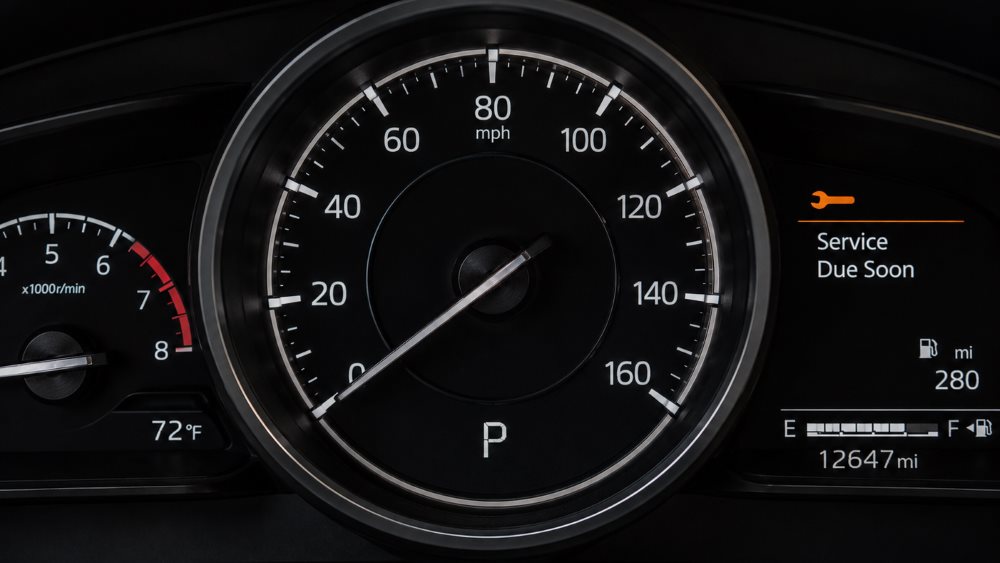
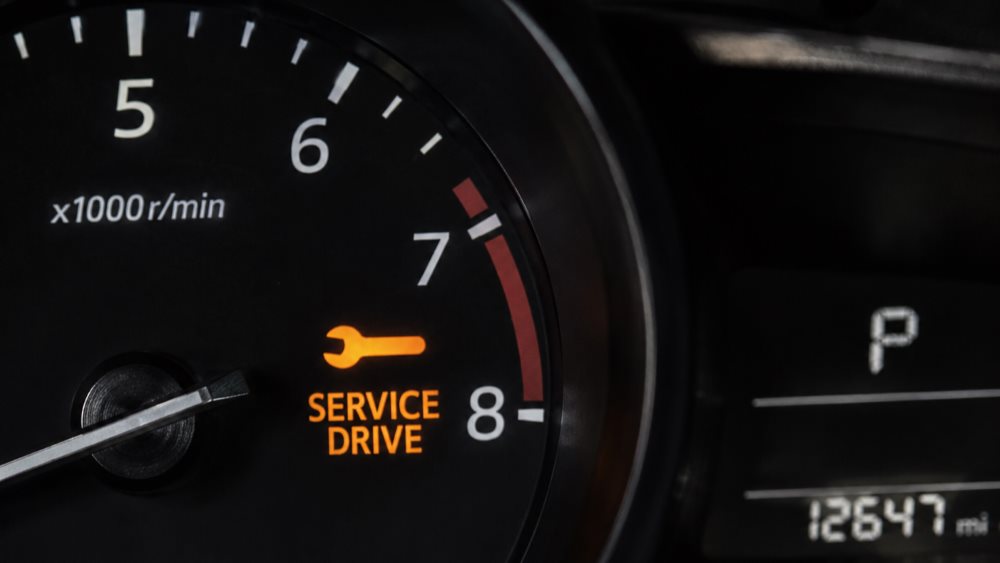
Most current Mazdas use a flexible oil-maintenance monitor. Rather than a fixed mileage, the vehicle estimates remaining oil life from how it's actually driven and illuminates a wrench indicator in the instrument cluster when service is due. Under this flexible setting, Mazda's upper limit for an oil and filter change is 12 months or 7,500 miles, whichever comes first, and the monitor should be reset after every oil change. Owners who prefer a fixed schedule can have the oil changed at a set interval instead.
Mazda then splits everything else into two maintenance schedules:
- Schedule 1 (Normal): standard driving conditions.
- Schedule 2 (Severe / unique driving conditions): shorter intervals for tougher use.
This matters in Miami more than almost anywhere, because of how Mazda defines "severe." According to Mazda's maintenance guidance, the severe schedule applies if you regularly drive in conditions such as repeated short distances, dusty or sandy areas, extended brake use, areas with corrosive materials like salt, extended idling, or for long periods in extreme heat or extreme humidity. Stop-and-go commuting through Brickell and Downtown, coastal salt air, year-round heat and summer humidity check several of those boxes at once. That doesn't mean every Miami Mazda needs the severe schedule, but experienced technicians commonly find that South Florida driving lines up with Mazda's own severe-conditions criteria more often than not.
The Mazda maintenance schedule at a glance
The table below reflects Mazda's Normal schedule for the four-cylinder models. It's a general guide: exact items and intervals vary by model year and engine, and your owner's manual is authoritative. Inspections (I) check a component and address it only if needed; replacements (R) are scheduled regardless.
| Interval (whichever comes first) | Mazda OEM Recommended (Schedule 1 - Normal) |
|---|---|
| 7,500 mi / 12 mo | Replace engine oil & filter; rotate tires; multi-point inspection; lubricate locks and hinges |
| 15,000 mi | Above, plus inspect disc brakes, fuel lines/hoses and brake lines/hoses; replace cabin air filter (interval varies by model) |
| 30,000 mi | Above, plus inspect suspension, ball joints, wheel bearings, driveshaft boots and steering; tighten chassis/body fasteners; replace engine air filter (commonly ~30,000-45,000 mi by model) |
| 45,000 mi / 5 yr | Inspect exhaust system and heat shields |
| 60,000 mi | Routine items, plus service transmission fluid, inspect drive belts and brake fluid, and a thorough systems inspection |
| 75,000 mi | Replace spark plugs (naturally aspirated 2.5L); audibly inspect valve clearance and adjust if noisy |
| 120,000 mi / 10 yr | Replace engine coolant (Mazda FL-22), then every 60,000 mi / 5 yr thereafter |
Note on turbo models: The turbocharged 2.5L (offered on some Mazda3 and CX-30 trims) replaces spark plugs more often - commonly around 40,000 miles rather than 75,000. The CX-90's turbocharged inline-six follows its own intervals; see the model section below.
How Miami conditions shift the schedule
Here's where the Severe schedule comes in. The items don't change - the timing does. Under Mazda's severe-conditions guidance, the intervals below commonly tighten for South Florida drivers. Treat this as a starting point for a conversation with your advisor, not a fixed rule; final recommendations vary by vehicle condition and how you drive.
| Item | Schedule 1 (Normal) | Additional Miami-Conditions Consideration |
|---|---|---|
| Oil & filter | ~7,500 mi / 12 mo | Often closer to ~5,000 mi / 6 mo with heat, humidity, short trips and stop-and-go |
| Tire rotation | ~7,500 mi | Same or sooner; heat can accelerate tread wear |
| Cabin air filter | By model (~15,000–25,000 mi) | Commonly sooner with high pollen and humidity |
| Brake fluid | Inspect; replace per manual | Humidity can accelerate moisture absorption - have it checked at service |
| 12V battery | Inspect at each visit | Heat shortens battery life; weakness is commonly observed sooner in South Florida |
| AWD driveline fluids | Per schedule | Severe-use vehicles may benefit from earlier service |
Mazda maintenance schedule by model

The core schedule above applies across the lineup, but the engine and drivetrain change a few specifics - most importantly the oil viscosity and the spark-plug interval. Here's what's different for each model.
Mazda3 maintenance schedule
The Mazda3 comes with one of two engines, and they don't take the same oil. The naturally aspirated 2.5-liter Skyactiv-G uses 0W-20; the turbocharged 2.5-liter (2.5 Turbo) uses 5W-30. That difference carries through ownership, so confirm which engine you have. Spark plugs are due around 75,000 miles on the naturally aspirated engine and roughly 40,000 miles on the turbo. The Mazda3 is offered in front-wheel drive and all-wheel drive; all-wheel-drive cars add transfer-case and rear-differential fluid to the long-term schedule, which experienced technicians often recommend servicing sooner under severe use. Everything else follows the standard Mazda intervals above.
Mazda CX-30 maintenance schedule
Mechanically the CX-30 is the Mazda3's crossover sibling and follows essentially the same schedule. It uses the same engine choices - naturally aspirated 2.5L on 0W-20 and the available 2.5 Turbo on 5W-30 - with the same 75,000-mile (naturally aspirated) and ~40,000-mile (turbo) spark-plug intervals. Many CX-30s are all-wheel drive, so the same driveline-fluid considerations apply. For a Miami commuter, the oil-and-rotation rhythm is the part you'll touch most often, and the severe-conditions timing is where it tends to land.
Mazda CX-5 maintenance schedule (all-new 2026)
The CX-5 is worth a closer look because the 2026 CX-5 is an all-new, third-generation model. In the U.S. it launches with a single recalibrated 2.5-liter Skyactiv-G four-cylinder (about 187 horsepower) paired with a six-speed automatic and standard i-Activ all-wheel drive on every trim - there is no turbo in the new lineup, and a Mazda Hybrid version is confirmed for the 2027 model year. Because it's the naturally aspirated 2.5, it uses 0W-20 and the longer ~75,000-mile spark-plug interval. Two practical notes: first, since AWD is standard, transfer-case and rear-differential service is part of every CX-5's long-term plan, not an option; second, because this generation is brand new, the 2026 owner's manual is the most accurate reference for its specific intervals, and we'd encourage confirming them with an advisor rather than assuming they carry over unchanged from the prior generation.
Mazda CX-90 maintenance schedule
The CX-90 is the outlier in this group, and its maintenance reflects that. The mainstream version uses a turbocharged 3.3-liter inline-six (e-Skyactiv-G) with a 48-volt mild-hybrid system and an eight-speed automatic, with all-wheel drive standard. That engine takes 0W-20 but a noticeably larger volume - roughly 6.3 quarts - and its spark-plug and transmission-fluid intervals differ from the four-cylinder models, so the CX-90 owner's manual is the authoritative reference rather than the general table above. There's also a CX-90 PHEV, which pairs a 2.5-liter naturally aspirated engine with a plug-in hybrid system. Its high-voltage battery does not require routine scheduled service; the hybrid system is checked as part of normal maintenance, and any high-voltage diagnostics are performed only if symptoms are present. For both versions, the larger size and standard AWD make the driveline-fluid and brake items more meaningful over time, especially under Miami's heat and stop-and-go conditions.
Why Miami conditions shorten your Mazda's real-world intervals
Mazda's severe schedule isn't a marketing upsell - it's the manufacturer's own guidance for tougher operating conditions, and South Florida hits several of them. Here's how each one tends to show up in our service bay.
Year-round heat
Sustained high temperatures are hard on a few systems at once. Heat accelerates the breakdown of engine oil, which is part of why the severe oil interval exists. It's also tough on the 12-volt battery - high under-hood temperatures shorten battery life, and we commonly see South Florida batteries weaken earlier than owners expect, sometimes well before the typical replacement window. Having the battery tested at each service visit is one of the simplest ways to avoid a no-start in a parking garage at peak summer heat.
High humidity
Brake fluid is hygroscopic, meaning it absorbs moisture from the air over time. In a humid climate that process can move faster, which is why brake-fluid condition is worth checking at service even before a fixed replacement interval arrives. Humidity also contributes to cabin-air-filter loading and can encourage corrosion, so the cabin filter and the visual corrosion checks during inspection earn their keep here.
Coastal salt air
You don't need road salt to get salt exposure near the coast. Airborne salt can contribute to corrosion of the undercarriage, brake lines, fasteners and electrical connectors over time - the same category of issue Mazda's severe schedule calls out for "areas with corrosive materials." This is one reason the multi-point inspection matters: it's where a technician catches early corrosion before it becomes a more involved repair.
Short trips and stop-and-go traffic
Commuting between Brickell, Downtown and the surrounding neighborhoods often means short distances and a lot of stop-and-go. Short trips don't always let the engine reach full operating temperature, which allows moisture and unburned fuel to accumulate in the oil, and extended idling and frequent braking add wear. All of this is squarely within Mazda's severe-conditions definition, and it's a big part of why a Miami Mazda's real-world service rhythm tends to be shorter than the Normal-schedule numbers suggest.
Dealer vs. independent shop: an honest take
We're a Mazda dealer, so you'd expect us to say "always come to us." We won't. For routine work - oil and filter changes, tire rotations, cabin air filters, basic inspections - a reputable independent shop is genuinely fine, and often cheaper on labor, as long as they use the correct oil viscosity for your specific engine and reset the maintenance monitor afterward (some quick-lube shops skip the reset).
Where a Mazda dealer adds value is the model-specific and warranty-sensitive work: when your Mazda has an open recall, when a Technical Service Bulletin applies, when you want the diagnostic depth of Mazda's M-MDS tooling during an inspection, or when a service needs to be documented to protect warranty coverage. Diagnostics like M-MDS scans aren't a routine line item - they're used when there's a symptom or a reason to look deeper. And if you bought your Mazda new from us, it's worth checking whether your complimentary maintenance coverage is still active before paying out of pocket.
How to keep Mazda maintenance affordable in Miami
Routine maintenance is a recurring cost, but there are a few ways to manage it at Brickell Mazda without cutting corners:
- Complimentary maintenance on new Mazdas: new Mazda purchases from Brickell Mazda include a period of complimentary scheduled maintenance - if you recently bought new, confirm your coverage is active before paying for routine service.
- Mazda Pre-Paid Maintenance: Mazda offers pre-paid maintenance plans that can lock in covered services at today's pricing; ask an advisor whether it pencils out for your driving.
- Service specials and the multi-point inspection: our current service coupons can reduce the cost of routine items, and the multi-point inspection included with service catches small issues before they become expensive ones.
Note: Offer terms and expiration dates may change without notice - verify current offers directly on our specials page before scheduling.
Frequently asked questions
How often does a Mazda need service?
Under Mazda's Normal schedule, plan on an oil and filter change, a tire rotation and a multi-point inspection roughly every 7,500 miles or 12 months, with larger services at 15,000, 30,000 and 60,000 miles. Under severe conditions - which include the heat, humidity and stop-and-go common in Miami - the oil interval in particular commonly tightens toward every 5,000 miles or 6 months.
What is Mazda's severe maintenance schedule, and do I need it?
Mazda publishes a Severe (or "unique driving conditions") schedule with shorter intervals for tougher use - repeated short trips, dusty conditions, extended idling, corrosive salt exposure, and extreme heat or humidity. Whether your Mazda needs it depends on how you actually drive, but South Florida conditions line up with several of Mazda's severe criteria, so it's worth discussing with an advisor.
How often should I change the oil in my Mazda?
Mazda's flexible oil monitor allows up to 7,500 miles or 12 months between changes under normal driving, signaled by the wrench indicator. Many Miami drivers land closer to 5,000 miles or 6 months because of heat and short-trip driving. The correct oil also depends on your engine for example, the naturally aspirated 2.5L uses 0W-20 while the 2.5 Turbo uses 5W-30.
When do Mazda spark plugs need to be replaced?
On the naturally aspirated 2.5L engine (Mazda3, CX-30, the 2026 CX-5), spark plugs are commonly due around 75,000 miles. On the turbocharged 2.5L, the interval is shorter -- roughly 40,000 miles. The CX-90's turbocharged inline-six follows its own interval; check the owner's manual.
Does the CX-5, Mazda3, CX-30 and CX-90 follow the same schedule?
The core schedule is shared, but the details differ by engine. The Mazda3, CX-30 and 2026 CX-5 use four-cylinder engines on the standard intervals (with oil type depending on whether it's the naturally aspirated 2.5 or the turbo). The CX-90 uses a larger turbocharged inline-six (or a plug-in-hybrid four-cylinder) with a bigger oil capacity and its own intervals, so its owner's manual is the better reference.
Is the 2026 CX-5 maintenance different from older CX-5s?
The 2026 CX-5 is an all-new generation with a single naturally aspirated 2.5L engine and standard all-wheel drive. The fundamentals follow Mazda's usual schedule, but because the platform and powertrain are new, the 2026 owner's manual is the authoritative source for its specific intervals - don't assume they carry over unchanged from the prior generation.
Does skipping scheduled maintenance affect my Mazda warranty?
Keeping up with scheduled maintenance and retaining your service records helps protect warranty coverage; neglecting required maintenance can complicate warranty-related claims if a failure is tied to a lack of service. The maintenance itself - oil changes, rotations, inspections - is the owner's responsibility and isn't covered by the standard warranty.
How much does Mazda scheduled maintenance cost at Brickell Mazda?
It depends on the model, the mileage milestone and what's actually due. Routine oil-and-rotation visits are the most affordable; larger 30,000- and 60,000-mile services run higher because more items come due. For current pricing, see our service specials or call (786) 481-4541 for an estimate based on your vehicle.
Schedule your Mazda service in Miami
Whether your Mazda is due for a routine oil change or a major-milestone service, our factory-authorized team can tell you exactly what's recommended for your model, mileage and driving conditions. Stop by Brickell Mazda at 618 SW 8th St, call (786) 481-4541, or book online.
About Brickell Mazda Service Center
Brickell Mazda is a factory-authorized Mazda dealer and service center serving Miami-Dade from 618 SW 8th St on the Calle Ocho corridor, minutes from Brickell and Downtown Miami. Our service department uses genuine Mazda parts and factory procedures to maintain the full Mazda lineup, including the CX-5, Mazda3, CX-30, CX-90 and Mazda's hybrid and plug-in-hybrid models.
This guide reflects Mazda's published maintenance schedule and is intended as educational information. Intervals and required services vary by model, engine, model year and driving conditions; your owner's manual and a Mazda service advisor are the final word for your specific vehicle. Final recommendations may vary by vehicle condition and advisor. Published June 10, 2026 · Last reviewed June 10, 2026.