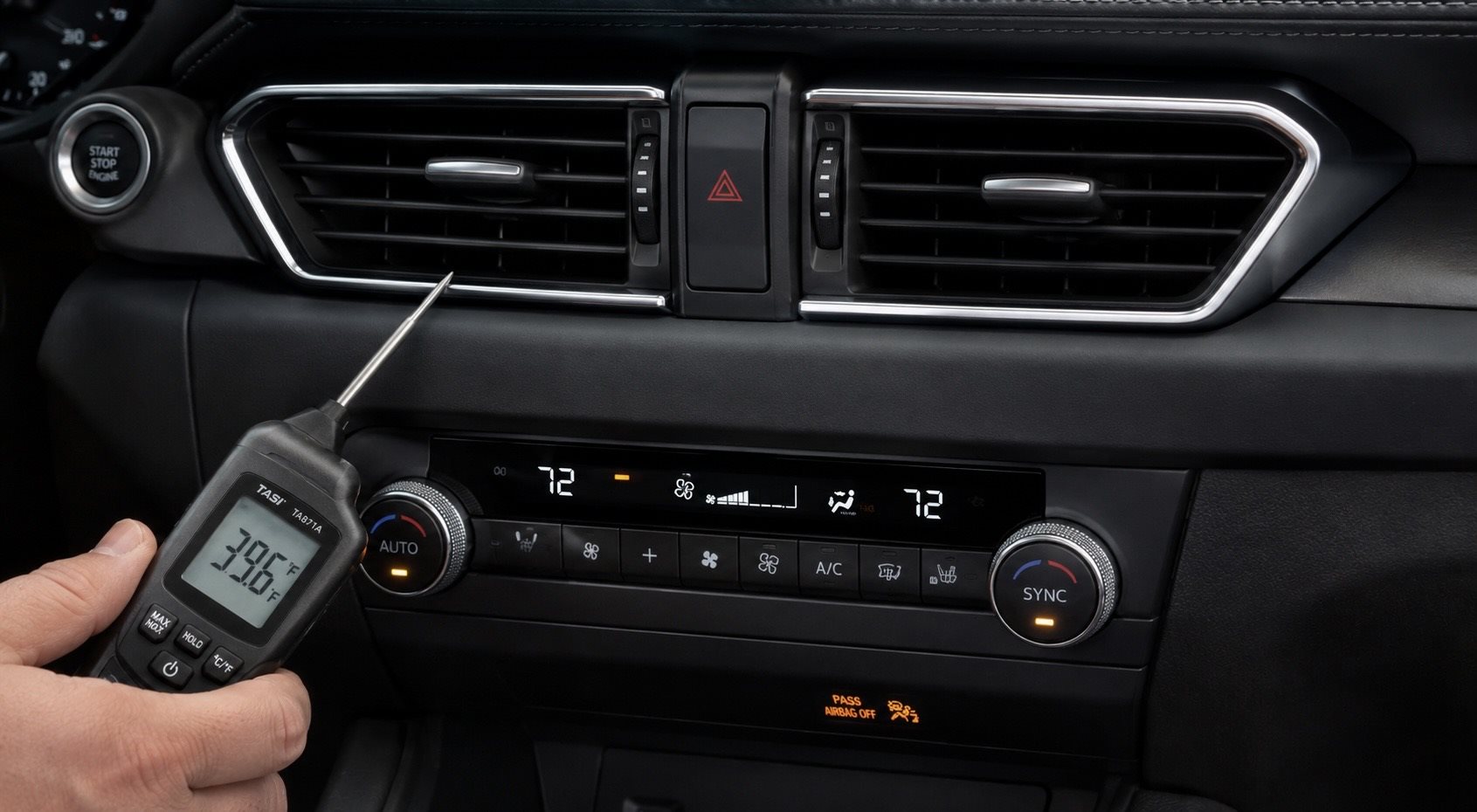
About this guide: Written by the Mazda-trained service team at Brickell Mazda, 618 SW 8th St in Miami, and last reviewed July 2026. We service Mazda vehicles across Brickell, Coral Gables, Coconut Grove, Key Biscayne and greater Miami-Dade using Genuine Mazda Parts and Mazda dealer diagnostic equipment. This article explains how A/C symptoms are commonly interpreted. It is not a diagnosis of any individual vehicle.
If your Mazda's air conditioning is blowing warm in Miami, the first useful question is not "what broke." It is whether you have a cooling problem or an airflow problem. Plenty of air that is not cold points toward refrigerant charge, the compressor, or the condenser. Cold air that barely reaches you points toward the cabin air filter, the blower, or a blend door. Those are different repairs at very different costs, and you can usually tell which one you have in about five minutes in your driveway. Brickell Mazda offers a complimentary A/C check if you would rather have it measured. Call (786) 481-4541.
Start Here: Five Minutes in Your Driveway
Start the car. Set climate control to maximum cool, maximum fan, and press recirculation so the system pulls cabin air rather than hot outside air. Let it run three to four minutes. Then check two things: how much air is coming out, and how cold it is.
| What you notice | Commonly points toward |
|---|---|
| Air is cold, but there is very little of it even at max fan | Airflow: clogged cabin air filter, blower motor or resistor, mode door fault |
| Plenty of air, but it is warm or only mildly cool | Cooling: low refrigerant charge, compressor not engaging, condenser restriction |
| Cold on the highway, warm in stop-and-go traffic | Condenser airflow: blocked condenser face, cooling fan fault, or a charge low enough to only cope with ram air |
| Cold on one side only, on a dual-zone system | Air distribution: blend door actuator or control fault, not usually refrigerant |
| Musty smell for the first minute after startup | Moisture and biofilm on the evaporator, or a restricted condensate drain |
| Rapid clicking from under the hood when A/C is on | Compressor short-cycling, commonly associated with low charge |
Note: These are patterns commonly observed in service, not a diagnosis. Symptoms overlap and more than one can be present at once. The table is meant to help you describe the problem accurately, which materially shortens diagnostic time.
What Each Side Usually Means
Airflow: the cabin filter first
The cabin air filter is a common airflow restriction and the one most often overlooked, because a filter does not fail. It fills. South Florida is unusually hard on them: construction dust, sea-salt aerosol near the coast and causeways, seasonal Saharan dust, and pollen. A filter sitting in a humid airbox also holds moisture, which feeds the musty smell described below.
Mazda publishes cabin air filter replacement in its scheduled maintenance, and the interval varies by model and by whether your driving qualifies for the unique-driving-conditions schedule. Check your owner's manual or MyMazda rather than a generic mileage figure. Experienced technicians often recommend inspecting the filter more frequently than the baseline interval for vehicles driven daily in Miami conditions, and replacing it when condition warrants rather than strictly on mileage. On most Mazda models it sits behind the glovebox and is genuinely owner-accessible. If the filter is clean and airflow is still weak, the blower motor, its resistor, and the blend and mode doors are next, and those are electrical diagnoses rather than refrigerant ones.
Cooling: refrigerant does not get used up
Low charge is a common cause of reduced cooling, and the key point is that these systems are not designed to be topped up. Refrigerant is not consumed. If the charge is low, it left, usually through slow permeation at hose walls, seals, O-rings and service port valves over a period of years. Slow loss being ordinary does not make it self-correcting: a charge found low should still prompt a leak evaluation before any refrigerant is added.
That is why "just add refrigerant" is usually the wrong instinct. Adding refrigerant to a leaking system buys a season at most, and overcharging produces worse cooling, not better, along with higher head pressure the compressor pays for. If the compressor never engages at all, the cause may lie in compressor operation or its control circuit, or in a low-pressure lockout, which is a protective feature: the system refuses to run the compressor when charge is too low to carry oil through it. The compressor is commonly the most expensive component in the system to replace, which is the practical argument for addressing a small leak early.
The condenser, and why traffic exposes it
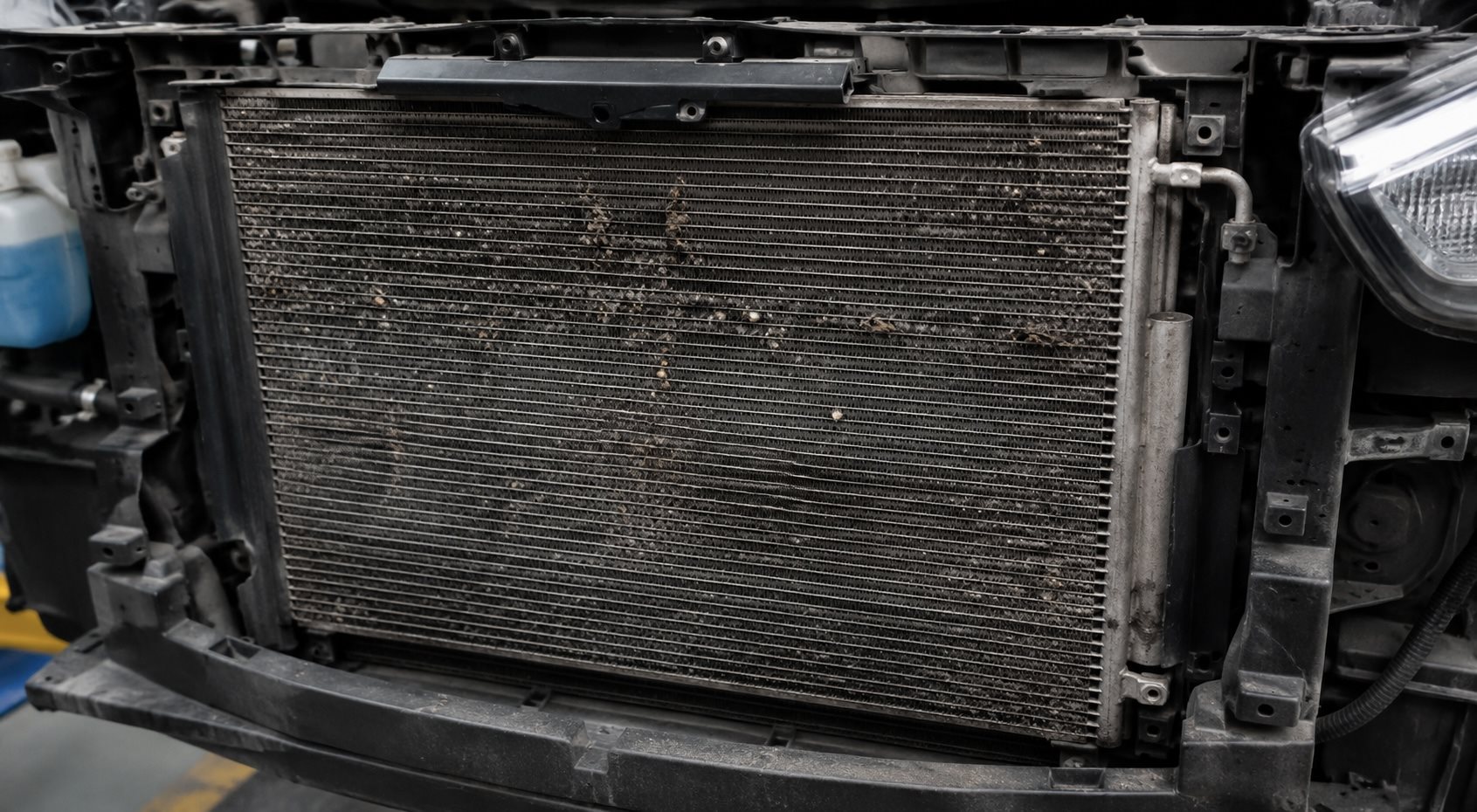
The condenser sits at the very front of the vehicle, in the path of everything the road throws forward. Fins pack with grit, bugs and salt residue, and that reduces heat rejection well before any refrigerant escapes. This is the mechanism behind "cold on the highway, warm in traffic," which we hear constantly from drivers on the I-95 corridor and US-1. At speed, ram air pushes through the condenser regardless of restriction. Sitting still on Brickell Avenue, the system depends entirely on the cooling fan pulling air through a restricted core. If your A/C is fine at 60 mph and disappointing at a red light, the condenser and fan circuit deserve attention before anyone reaches for a refrigerant gauge.
Which Refrigerant Does Your Mazda Actually Use?
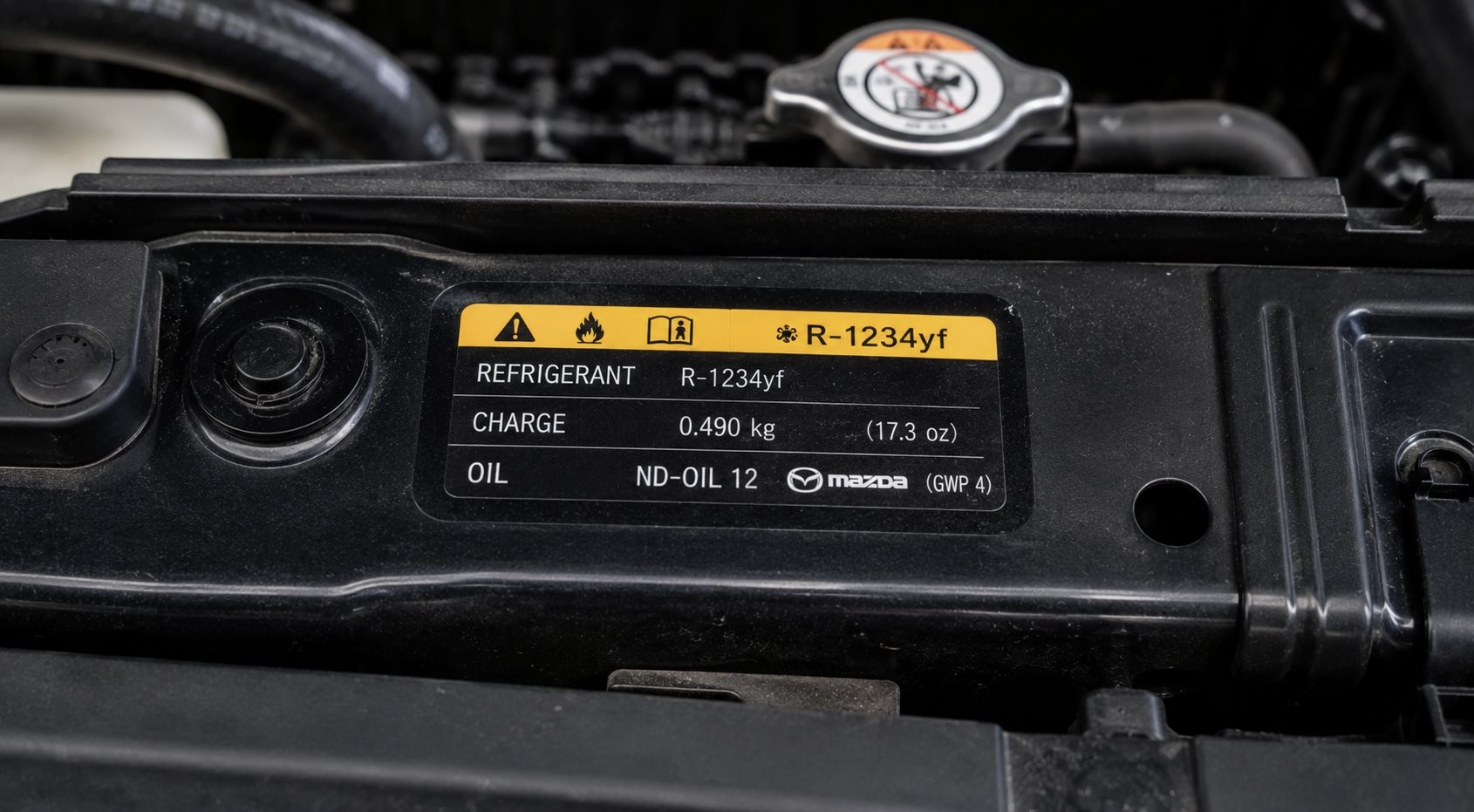
This matters more than most owners expect. The industry moved from R-134a to R-1234yf, and the two are not interchangeable: different service equipment, different fittings, different compressor oil specification. Mixing them contaminates both the vehicle and the shop's recovery equipment.
Here is the part almost no guide gets right: the underhood label, not the model year, is the controlling source. The transition happened across the Mazda lineup over several model years, and within a single nameplate and year it could differ by engine variant and VIN range. Mazda service documentation covering 2017-2018 CX-5 lists R-134a specifications for some engine variants and R-1234yf for others, in the same model years, with four distinct charge-weight ranges depending on configuration. Your neighbor's 2018 CX-5 is not a reliable guide to yours.
| Model year | What to generally expect |
|---|---|
| 2013 and earlier | Generally R-134a. Confirm on the underhood label. |
| 2014 - 2020 | Mixed. Varies by model, engine variant and in some cases VIN range. Checking the label is required, not optional. |
| 2021 and newer | R-1234yf. US federal rules required it for new vehicles from model year 2021. Confirm on the underhood label regardless. |
Finding the label takes thirty seconds. Open the hood and look on the underside of the hood, the radiator support, or near the compressor. It states the refrigerant type and charge weight for your specific vehicle. Photograph it. It is the single most useful thing you can bring to any A/C conversation.
Note on DIY recharge cans: R-1234yf service ports are physically designed to reject R-134a equipment, so the fitting will not connect. That mismatch is a safety feature and it is the good outcome. The bad outcome is a system charged by guesswork rather than by weight. These systems are specified in grams, and the tolerance is narrower than most consumer kits can hold.
Why Miami Is Harder on A/C Than Almost Anywhere Else
Most national A/C content is written for a climate with a season. South Florida does not have one, and that single fact changes the maintenance picture.
No off-season, so hours accumulate
In most of the country an A/C system runs perhaps four months a year. Here it runs essentially every drive, every month. Compressor operating hours, cycling and seal wear accumulate at something closer to double the national rate. Every system also loses a very small amount of refrigerant over time through hose walls and seal interfaces. That is normal and slow. What matters is when the charge drops below the point where cooling falls off, and sustained heat accelerates the rubber degradation that governs the rate. It is commonly observed here as systems that were fine for six or seven years and then seemed to decline over a single summer. Nothing broke suddenly. The system crossed a threshold.
Coastal salt and stop-and-go traffic both hit the condenser
Salt-laden air is a corrosion factor for the condenser and its fins, and it reaches them directly because the condenser is the frontmost heat exchanger on the vehicle. Vehicles driven across the causeways to Key Biscayne or Miami Beach, or parked near the water, see more of this exposure than vehicles kept inland, and fin corrosion degrades heat rejection quietly without ever producing a leak. Traffic compounds it: Brickell Avenue at 6 PM is maximum cabin heat load, maximum underhood temperature, and zero ram air.
Humidity keeps the evaporator wet
The evaporator runs cold in humid air, so condensation is continuous and by design. It drains out under the car, which is why a puddle under a parked car on a hot day is normal. When that drain restricts, or the core stays damp in a humid airbox, you get the musty smell that appears for the first thirty seconds after startup. That is an odor issue rather than a cooling one, and it is common enough here to be worth naming separately.
Model-Specific Notes
The underlying architecture is similar across the lineup, so the diagnostic logic above applies broadly. These are the points worth knowing by model.
| Model | Worth knowing |
|---|---|
| Mazda3, CX-30 | Shared platform generation and closely related HVAC packaging. Cabin filter behind the glovebox and among the more owner-accessible in the segment. |
| CX-5 | One of the Mazda models most frequently seen in our service department. 2017-2018 vehicles were built with both refrigerant types depending on engine variant and VIN range. Photograph the label before booking A/C work. |
| CX-50 Hybrid, CX-90 PHEV | Hybrids and plug-in hybrids typically use an electrically driven compressor rather than a belt-driven one, which is why the cabin keeps cooling with the engine off. Different service requirements and oil specifications apply. Mention it when you book. |
| CX-70, CX-90 | Large three-row cabins carry a much bigger heat load, so a charge deficiency shows up sooner and typically appears first as poor third-row cooling. Rear ducting is a separate diagnostic path from front-seat cooling. |
| MX-5 Miata | Small cabin, large glass area, soft top with limited thermal insulation. Far more solar gain per cubic foot, so a modest charge deficiency feels dramatic. Recirculation matters more here than anywhere in the lineup. |
| CX-9 and older | Ran through 2023. Many Miami examples are past the age where original hoses and O-rings have seen continuous thermal cycling, so a leak search is generally more productive than a recharge. |
For a broader view of what tends to come up by model and year, see our guide to known Mazda issues by model for Miami owners.
What a Real Diagnosis Involves
A credible A/C diagnosis is a measurement process, not a guess. It generally includes reading high-side and low-side pressures against the manufacturer's parameters for the specific vehicle, measuring vent temperature under load, verifying compressor engagement and cycling behavior, inspecting the condenser face and cooling fan, checking the cabin filter and blower, and a leak search where pressures suggest one. Where symptoms point to an electrical or control fault, manufacturer-level diagnostic equipment may be recommended to read climate control data directly. That is a symptom-driven step rather than a routine one, and it should be explained to you before it is performed.
Brickell Mazda's complimentary A/C check covers six points: refrigerant level, compressor operation, drive belt and hose condition, cabin air filter condition, vent outlet temperature under load, and a high and low side pressure test. It typically runs 20 to 30 minutes, and you receive a written estimate before any work is authorized. Scope and availability can change, so confirm what is included when you schedule. See the current complimentary A/C check details.
When an Independent Shop Is Perfectly Fine
We are a Mazda dealer, so treat what follows accordingly, but we would rather be useful than promotional. An independent shop, or your own driveway, is genuinely reasonable for cabin air filter replacement, clearing debris off the condenser face, basic control-setting troubleshooting, and a straightforward leak test and recharge on an older out-of-warranty vehicle, provided the shop has equipment matched to your refrigerant type. Many independent A/C specialists in Miami are excellent.
A Mazda dealer is the better call for anything potentially covered under factory or certified pre-owned warranty, hybrid and plug-in hybrid systems with electrically driven compressors, climate faults requiring manufacturer-level system data, any case where refrigerant type is uncertain, and vehicles where a service bulletin may apply. The one thing we would push back on regardless of who does the work: do not let anyone add refrigerant without establishing why it was low.
What A/C Service Costs at Brickell Mazda
We will be direct. Brickell Mazda does not publish fixed pricing for A/C repair, recharge, compressor or condenser work, and we are not going to invent a range here. Cost is driven by which component failed and by the refrigerant type and charge weight your specific vehicle requires, and a number quoted in an article is more likely to mislead you than help. Call (786) 481-4541 for a written estimate after diagnosis.
On current offers: Brickell Mazda periodically runs A/C inspection offers, cabin air filter discounts, tiered parts-and-service savings, and complimentary pickup and delivery within a set radius. Terms, thresholds, exclusions and expiration dates change, so we are not restating them here. Review our current service specials for active terms before scheduling, and ask your advisor which offers apply to the work your vehicle needs.
One practical note on sequencing. If the driveway test pointed toward airflow rather than cooling, start with the cabin air filter. It is the least expensive item in this article and it resolves a meaningful share of "my A/C got weak" complaints. There is no reason to authorize refrigerant service to fix a problem a filter is causing.
Frequently Asked Questions
Why is my Mazda's A/C cold on the highway but warm in traffic?
This points toward condenser airflow rather than refrigerant charge alone. At speed, air is forced through the condenser regardless of restriction. In stop-and-go the cooling fan has to do all of it. A condenser packed with debris, a fan circuit fault, or a charge low enough to only cope with the easy case will all present this way. It is one of the more diagnostically useful symptoms you can report.
Can I just add refrigerant myself?
On an older R-134a vehicle you physically can, but it is rarely the right move. These systems do not consume refrigerant, so a low charge means it escaped. Adding more without finding the leak treats the symptom for a season, and overcharging degrades cooling and raises system pressure. On R-1234yf vehicles the service ports are designed to reject R-134a equipment, so most consumer kits will not connect at all.
How do I know which refrigerant my Mazda uses?
Check the underhood label, which states type and charge weight. Do not go by model year. Mazda transitioned across the lineup over several model years, and 2017-2018 CX-5 vehicles in particular were built with both types depending on engine variant and VIN range.
Why does my Mazda's A/C smell musty when I first turn it on?
The evaporator runs cold in humid air, stays damp, and in Miami rarely gets a chance to fully dry. Moisture plus organic material on the core produces the odor, and a restricted condensate drain makes it worse. A loaded cabin filter contributes as well. Running the fan without A/C for the last minute or two of a drive helps dry the core, and it is a habit worth building here.
Is it bad to run the A/C constantly in Miami?
No, and running it regularly is arguably better than not. Seals and O-rings stay lubricated when the system circulates, which is part of why vehicles that sit unused often develop leaks. The real consideration is that continuous year-round operation accumulates wear faster than in seasonal climates, which is the case for periodic inspection rather than for using it less.
My A/C stopped working entirely rather than gradually. What does that suggest?
A sudden and complete loss of cooling more often suggests an electrical or control fault, a compressor engagement failure, or a low-pressure lockout from significant refrigerant loss, rather than the slow permeation pattern described above. The distinction between gradual decline and abrupt failure is worth mentioning to your advisor, because it narrows the diagnostic path considerably.
Schedule an A/C Check in Miami
If your Mazda is not cooling the way it used to, the driveway test at the top of this article will tell you a great deal, and a measured check will tell you the rest. Our Mazda-trained technicians work from factory specifications for your specific configuration rather than generic parameters.
Service Department: (786) 481-4541
Service Hours: Monday - Friday 7:00 AM to 6:00 PM | Saturday 8:00 AM to 4:00 PM | Sunday closed
Location: 618 SW 8th St, Miami, FL 33130
Recommendations vary by vehicle condition, configuration, mileage and service advisor assessment. Findings from an inspection are specific to the vehicle inspected. Offer terms and expiration dates may change without notice - verify current offers on our service specials page before booking.
About Brickell Mazda Service Center
Brickell Mazda is a factory-authorized Mazda dealership and certified service center at 618 SW 8th St in Miami, FL 33130, operated by Murgado Automotive Group. Our service department is staffed by Mazda-trained technicians using Genuine Mazda Parts and Mazda dealer diagnostic equipment, serving Mazda owners across Brickell, Coral Gables, Coconut Grove, South Miami, Key Biscayne, Miami Beach and greater Miami-Dade County. We service Mazda3, CX-30, CX-5, CX-50, CX-70, CX-90 and MX-5 Miata across all model years, and we service all makes and models.
This guide describes diagnostic patterns commonly observed in South Florida service conditions and is intended as educational information. It is not a diagnosis of any individual vehicle. For an assessment specific to your Mazda, consult a Mazda-certified technician. Published July 23, 2026 - Last reviewed July 23, 2026.